Tales from outer turnip head...

Tales from outer turnip head...
Showing posts with label Zen. Show all posts

Sunday, May 27, 2018

A Buddhist still life: smiling

Smile today...

"Life is both dreadful and wonderful. To practice meditation is to be in touch with both aspects. Please do not think we must be solemn in order to meditate. In fact, to meditate well, we have to smile a lot." -- Thich Nhat Hanh
Even though life is hard, even though it is sometimes difficult to smile, we have to try. Just as when we wish each other, "Good morning," it must be a real "Good morning." Recently, one friend asked me, "How can I force myself to smile when I am filled with sorrow? It isn't natural." I told her she must be able to smile to her sorrow, because we are more than our sorrow. -- Thich Nhat Hanh


Breathing in, I calm my body.
Breathing out, I smile.
Dwelling in the present moment
I know this is a wonderful moment.

--Thich Nhat Hanh

Sunday, February 11, 2018

A Buddhist Still Life... nowhere and nothing

What is the sound of moss growing?: Many years ago my college mentor exposed me to a book in the course of our studying an introduction to the experiences of religion; The book: The Tao of Pooh by Benjamin Hoff. It is one those books that changes you for the better having read it, enough that you wish to share your changes with others. The funny part about this book was how little specific "information" I remembered after reading it the first time. I couldn't quote a thing, or even point to much specific evidence at all despite having thought time and time again how cool/cute/profound a particular passage was.

It is a book about Taoism, a religion/philosophy that ironically would value the change I had experienced especially without analysis and label applied to trhat change. Funny... that I saw the ironic nature of my lessons and waited a long while before reading it again, that time in order to take notes. I never did take notes. The idea of documenting it seems to spoil my experience of the book, but I have read it several times since, each time learning something more about... "things"... from Pooh and his friends. Over the years I have gifted this book to friends and students who seem to "get life" and who might enjoy a moment of receiving a good read from a mentor. Here is a tidbit from the beginning of the chapter "Nowhere and Nothing" that I particularly like:

The Tao of Pooh
by Benjamin Hoff

"Where are we going?", said Pooh hurrying after him and wondering whether it was to be an Explore or a What-shall-I-do-about-you-know-what.

"Nowhere," said Christopher Robin.

So they began going there, and after they had walked a little way, Christopher Robin said:

"What do you like doing best in the world, Pooh?"

(And of course, what Pooh liked doing best was going to Christopher Robin's house and eating, but since we've already quoted that, we don't think we need to quote it again.)

"I like that too," said Christopher Robin, "but what I like best is Nothing."

"How do you do Nothing?" asked Pooh, after he had wondered for a long time.

"Well, it's what people call out at you just as you're going off to do it, What are you going to do, Christopher Robin, and you say, Oh, Nothing, and then you go and do it."

"Oh, I see," said Pooh.

"This is a nothing sort of thing that we're doing now."

"Oh, I see," said Pooh again.

"It means just going along, listening to all the things you can't hear, and not bothering."

Sunday, January 7, 2018

A Buddhist Still Life... making your bed

"So take your shower, shine your shoes, you got no time to lose. You are young and you must be living" --Dispatch:

"...start off by making your bed." --Admiral William H. McRaven:
 
In 2014 United States Navy admiral William H. McRaven delivered a commencement speech which "went viral" much like David Foster Wallace's "This Is Water" speech in 2005 at Kenyon College. McRaven has refined his message and written a book expanding on his words. The video has been viewed many millions of times now on YouTube and GoalCasts's Facebook page. I am particularly interested in the very beginning of his speech, which I have made bold in the transcript that follows. Much of Admiral McRaven's words are inspirational wisdom, but at the start he advises a simple act of doing: making your bed. Transcript:
If you want to change the world, start off by making your bed. If you make your bed every morning, you will have accomplished the first task of the day. It will give you a small sense of pride, and will encourage you to do another task, and another, and another. By the end of the day, that one task completed will have turned into many tasks completed. Make your bed will also reinforce the fact that the little things in life matter. If you can’t do the little things right, you’ll never be able to do the big things right. If, by chance, you have a miserable day, you will come home to a bed that is made. That you made. And a made bed gives you encouragement that tomorrow will be better.

To pass SEAL training, there are a series of long swims that must be completed. One is the night swim. Before the swim, the instructors joyfully brief the students on all the species of sharks that inhabit the waters off San Clemente. They assure you, however, that no student has ever been eaten by a shark. At least not that they can remember. But you are also taught that if a shark begins to circle your position, stand your ground. Do not swim away. Do not act afraid. If the shark, hungry for a midnight snack, darts towards you, then summon up all your strength and punch him in the snout, and he will turn and swim away. There are a lot of sharks in the world. If you hope to complete the swim, you will have to deal with them. If you want to change the world, don’t back down from the sharks.

Over a few weeks of difficult training, my SEAL class, which started with 150 men, was down to just 42. There are now six boat crews of seven men each. I was in the boat with a tall guys, but the best boat crew we had was made up of little guys, the munchkin crew, we called them. No one was over five foot five. The munchkin boat crew had one American Indian, one African American, one Polish American, one Greek American, one Italian American, and two tough kids from the Midwest. The out-paddled, out-ran, and out-swam all the other boat crews. The big men in the other boat crews would always make good natured fun of the tiny, little flippers the munchkins put on their tiny, little feet prior to every swim. But somehow these little guys, from every corner of the nation in the world, always had the last laugh, swimming faster than everyone and reaching the shore long before the rest of us.

SEAL training was a great equalizer. Nothing mattered but your will to succeed. Not your color, not your ethnic background, not your education, not your social status. If you want to change the world, measure a person by the size of their heart, not by the size of their flippers.

The ninth week of training is referred to as Hell Week. Is it six days of no sleep, constant mental and physical harassment, and one special day at the mud flats. The mud flats are an area between San Diego and Tijuana, where the water runs off and creates the Tijuana sloughs, a swampy patch of terrain where the mud will engulf you.

It is on Wednesday of Hell Week that you paddle down to the mud flats and spend the next 15 hours trying to survive the freezing cold, the howling wind, and the incessant pressure to quit from the instructors. As the sun began to set that Wednesday evening, my training class, having committed some egregious infraction of the rules, was ordered into the mud. The mud consumed each man until there was nothing visible but our heads. The instructors told us we could leave the mud if only five men would quit. Only five men. Just five men and we could get out of the oppressive cold. Looking around the mud flat, it was apparent that some students were about to give up. There were still over eight hours until the sun came up. Eight more hours of bone-chilling cold. The chattering teeth and shivering moans of the trainees were so loud, it was hard to hear anything.

Then one voice began to echo through the night. One voice raised in song. The song was terribly out of tune, but sung with great enthusiasm. One voice became two. And two became three. And before long, everyone in the class was singing. The instructors threatened us with more time in the mud if we kept up the singing, but the singing persisted. And somehow, the mud seemed a little warmer, and the wind a little tamer, and the dawn not so far away.

If I have learned anything in my time traveling the world, it is the power of hope. The power of one person. A Washington, a Lincoln, King, Mandela, and even the young girl from Pakistan, Malala. One person can change the world by giving people hope. So if you want to change the world, start each day with a task completed. Find someone to help you through life. Respect everyone. Know that life is not fair, that you will fail often. But if you take some risks, step up when the times are the toughest, face down the bullies, lift up the downtrodden, and never, ever give up, if you do these things, the next generation and the generations that follow will live in a world far better than the one we have today. And what started here will, indeed, have changed the world for the better.
https://www.goalcast.com/2017/08/17/william-h-mcraven/

Sunday, November 12, 2017

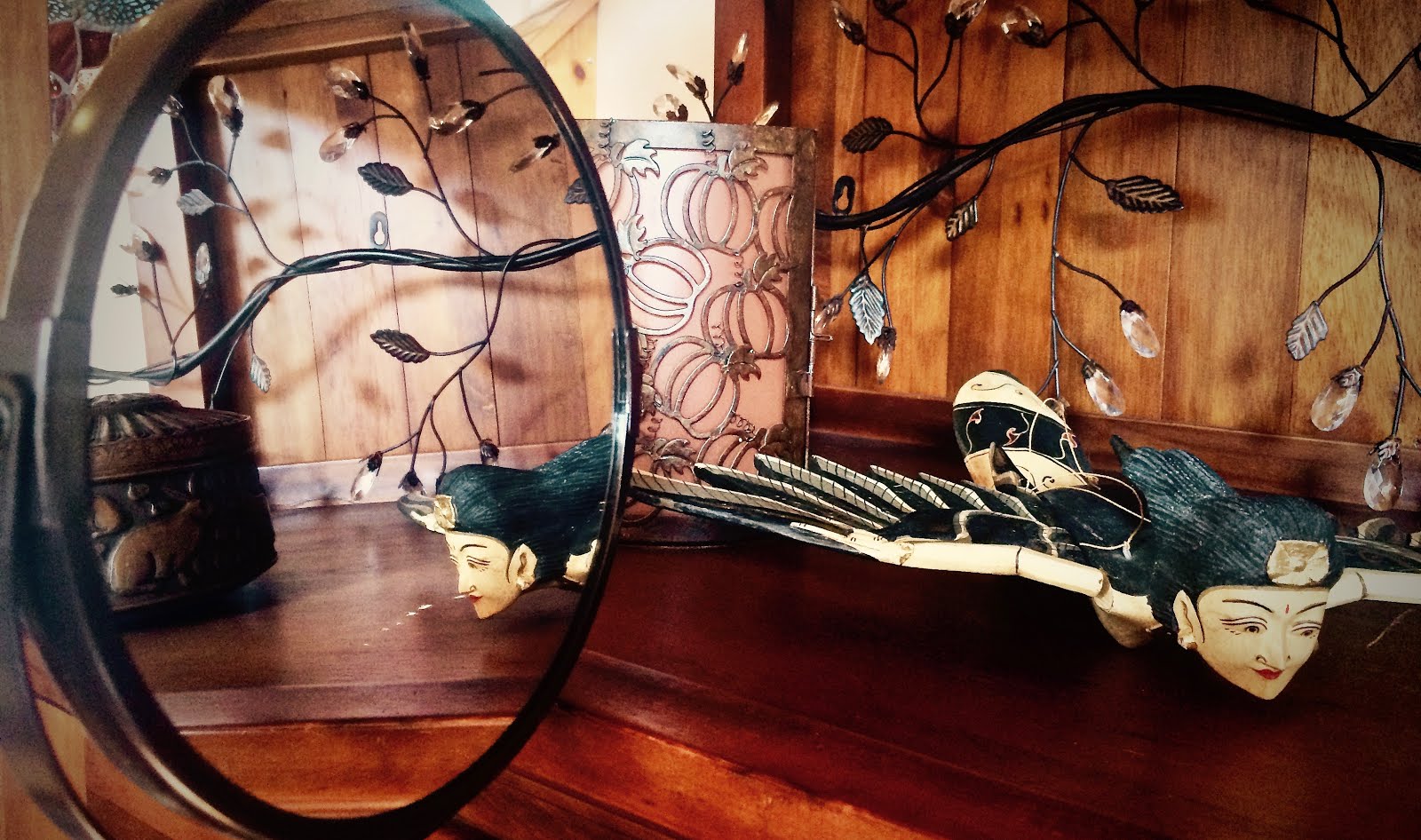
A Buddhist Still Life... mirrors

what is, simply is...

"The mirror is thoroughly egoless and mindless. If a flower comes it reflects a flower, if a bird comes it reflects a bird. It shows a beautiful object as beautiful, an ugly object as ugly. Everything is revealed as it is. There is no discriminating mind or self­consciousness on the part of the mirror. If something comes, the mirror reflects; if it disappears the mirror just lets it disappear ... no traces of anything are left behind. Such non-attachment, the state of no-mind, or the truly free working of a mirror is compared here to the pure and lucid wisdom of Buddha."

(Zenkei Shibayma, On Zazen Wason, Kyoto, 1967, p. 28) 
[Found in Zen and the Birds of Appetite by Thomas Merton]


Sunday, November 5, 2017

A Buddhist Still Life... weeding

"Pulling out the weeds we give nourishment to the plant. We pull the weeds and bury them near the plant to give nourishment."
The weeds of our lives entangle, starve, and choke-out the flowers we are striving to be. We are the weeds; we are the flower; we are the choking-out, and we are growing. As we tend our gardens and pull our weeds, we need to remember that the weeds should not be rejected, just as we should not reject ourselves, but rather we should bury our weeds near our flower selves so that they might continue to serve each other...

"When we see a part of the moon covered by a cloud, or a tree, or a weed, we feel how round the moon is. But when we see the clear moon without anything covering it, we do not feel that roundness the same way we do when we see it through something else."
The weeds of our selves can offer us perspective of the whole. We are so round, so whole, and the weeds and clouds of our lives only serve to show us that...

"For Zen students a weed, which for most people is worthless, is a treasure. With this attitude, whatever you do, life becomes art."
Accepting the weeds of our selves along with the fullness of the whole is the work of every day, of every moment, while walking, while sitting, while working. We practice this that we might rediscover our beginner selves, to be, and to love, and to be loved...

"But we must not be attached... We must have beginner's mind, free from possessing anything, a mind that knows everything is in flowing change. Nothing exists but momentarily in its present form and color. One thing flows into another and cannot be grasped. Before the rain stops we hear a bird. Even under the heavy snow we see snowdrops and some new growth. In the East I saw rhubarb already. In Japan in the spring we eat cucumbers." 

Quotes from Zen Mind Beginner's Mind, by Shunryu Suzuki

Sunday, May 15, 2016

A Buddhist Still Life... balance

"I'm not sure of what it all means yet... I'm not sure of much of anything these days. Maybe that's why I talk so much." -- Narrator in Zen and the Art of Motorcycle Maintenance (early in his Chautauqua)

Meditation: Greening Bodhi with dried cactus blossoms
Classical vs(?) Romantic: I am about 20 percent into Zen and the Art of Motorcycle Maintenance. It is one of several reads I am currently indulging in, choosing to crack the cover of my Kindle only while eating my cereal in the morning. [I am also savoring the newest volumes of two graphic novels that came in the mail recently and have just started a biography of John Peel.] In Zen, I have arrived at a philosophical section where the Narrator has begun expressing his ideas contrasting "classical" and "romantic" types of personalities. The "romantic" is exemplified by  the narrator's friend John, whom he describes as a conflicted (and perhaps lost) motorcycle rider who relies heavily on technology—while seemingly wanting to reject any need to understand the machines he hopes to operate properly. The narrator presents himself as more "classical," relying on his rational/logical problem-solving skills to keep his old bike in good repair. I am, in part, drawn to the narrator who loves to tinker and rely on his wits. He seems quiet and introspective, while at the same time claims he talks too much. I identify with that. I often describe myself as a "Pooh" trapped in a "Tigger." I have bought into the narrator's critique of John, yet worry that the narrator is missing how important it is to find a balance between both of the two personalities, a little classical to temper the romantic, a little romance to temper the classic. Balance is the key to a clean mind; logical and emotional; planning/preparing and remaining in the moment; analysis and experience...

Finding my balance: So this weekend I have been seeking my own sort of balance to address not knowing "what it all means yet." I do know that remaining in the moment is just so much nicer than trying to remain in a past moment or anticipate next moments. Balance came this weekend by getting my hands dirty...

First lilac buds over freshly tilled garden.
Getting my hands dirty, Part 1: Placing ones hands deep into rich soil after removing the top layer of rotting fall leaves feels almost as good as the warm shower one takes to get the sweat and dirt of a hard day's work off. What is it about prepping the ground for plants that is so satisfying? Prep work usually makes me cringe. (I love to just jump in and get things done.) For instance, painting prep is what keeps me from painting whenever I can avoid it. I'd rather just hit a canvas and go, adjusting as I will, hoping for something that looks like I feel inside. But prepping a room for paining, doing trim, after masking the electrical covers, etc. pushes my ability to remain patient. I can sit on a bench and watch the sun glisten on the lake for an afternoon, but I have no patience for preping a room to paint. And yet... getting the ground ready to receive plants feels much different. The crazy-garden-ladies [mentors of my first attempts to grow my own food] from Cambridge back in 1997 told me, "take care of the soil and the plants will take care of themselves." It has been one of the most important pieces of wisdom I have ever received. Prepping the soil doesn't even feel like prep work per say. It feels like the only real work of planting. Once I do my part, the plants will do theirs. I'll stick around and offer help when needed; the soil is my responsibility; the growing is theirs...

So phase one of soil prep is done. The lilacs are just starting to bloom by the way. The scent will be drifting across the lawn soon. The soil in their partial shade has been tilled and the rotting leaves await replacement as a top cover once my daughter and I pick our spring planting at the end of the month. I dug in the new dirt a little after the tilling was finished; my hands got dirty; my mind cleared...

'74 Honda CB 360: Opening the engine on frame. 
Getting my hands dirty, Part 2: The Honda has been sitting for months. When I last posted about Joe (my '74 Honda CB360 for those who have not been following my posts regularly) I described restoring the tank and surrounding parts. I have not finished writing my adventures-of-the-dual-carbs yet, but I have to spoil the next few posts on the bike blog by saying that I have gotten the bike to run, and have done a lap around the block. Oh my goodness! Never has 20 miles an hour felt so glorious as making Joe go. But the compression dropped off as things loosened up in that engine that hasn't run for over a decade. So my mentor and I have decided to take a look at the pistons and rings. I am not willing to describe the start of this adventure yet either, but I bring it up because "balance" this weekend came in part through successfully removing my tank without spilling a drop of gas, opening up the breather cover, and understandingly pulling apart the spark advancer and contact breaker assembly. This is not a big deal at all for anyone who knows how to turn wrench on a motorcycle. It's almost as rudimentary as changing a light switch for an electrician, or unclogging a sink drain for a plumber. But for me it was a first, and I knew what I was doing as I did it; And my hands got dirty; And my mind cleared...

Sunday, May 1, 2016

"This is the hardest stuff in the world to photograph..."

Finding some wisdom 30 years after the fact: Years ago while at summer camp I tried reading Robert Pirsig's Zen and the Art of Motorcycle Maintenance. I do not know if I was able to finish it or not, but it did not leave much of an impression on my conscious mind. I remember thinking it was not what I had expected it to be, but beyond that my memory fails me. I have picked it up again, nearly 30 years later and am having a different experience with it...

It started with a childhood desire to ride a bike: In December I bought an old motorcycle that is just about as old as me, and which has been sitting still for quite some time. I thought it would make a good metaphorical and practical project for me in my middle years to learn a new skill and bring a beat up—but potentially functional—machine back to a level of coolness that demands to be appreciated for it's ability to keep going with a little attention. And so I thought a book about motorcycle maintenance and the "metaphysics of quality"—as Pirsig calls his philosophy—might be a fun intellectual balance for my piston ring, carburetor valve, drum shoe repairs on my old Honda CB360...

Chapter 4 Excerpt, Zen and the Art of Motorcycle Maintenance: At one point early in the novel, the narrator, his son Chris, and two friends Sylvia and John arrive at the prairie. At a midday stop, Sylvia exclaims "It's so beautiful. It's so empty," while the narrator and his son stretch out on the ground to soak up some sunlight after a cool morning of riding. John gets his camera out:
After a while [John] says, “This is the hardest stuff in the world to photograph. You need a three-hundred-and-sixty-degree lens, or something. You see it, and then you look down in the ground glass and it's just nothing. As soon as you put a border on it, it's gone.”

I say, "That's what you don't see in a car, I suppose."

Sylvia says, "Once when I was about ten we stopped like this by the road and I used half a roll of film taking pictures. And when the pictures came back I cried. There wasn't anything there."
I've been where John and Sylvia were that moment. I spent years (and still do at times) trying to force the fullness of nature into the frame of a camera. I am working on trying to embrace the narrator's mindset: letting the moment be vs. capturing the moment for some unknown future use or share...

The Extra 12 proceeded my Canon AE1: When I was young I had a Kodak 110 camera and began trying to capture the world on film. Little cartridges of 110 film that has to be developed before any real feedback of the image could be assessed. [Such a different pre-digital world I grew up in.] My Uncle was a professional photographer and my father is an incredibly good shot himself. They offered advice on framing and "getting people in the shot." They let me experiment as I would though to learn the lessons myself. I wanted to be as good as they were with my photos, and I kept trying to capture the vastness of nature (and doing a terrible job at it); but I was determined to reject their advice so as to not spoil shots of nature with people. [So naive.] You see, my reluctance of taking pictures of people was in part formed by the frequent times when grown-ups forced us to endure hellaciously long-seeming moments of posing for a photo (before allowing us to get back to whatever was going on before the photo session was initiated); moments where we were assembled, maneuvered, and asked to pose in awkwardly frozen moments. This process was the worst when in the hands of my mother's mother, Alma. [Alma was an amazingly wonderful woman; she was generous and patient, kind and beautiful, loving and interested; but she was one of the worst photographers in the world.] She would pull out her camera, affix her blinding flash cubes to her ancient device, square off both hands on each side (elbows out at 90 degree angles), and spend the next bajillion moments telling us how to get ready for the picture, while accidentally getting her finger in front of the lens, and just plainly punishing us with her need to capture moment after moment after moment, the same as the year before, and the year before that, and on, and on, and on... It was god-awful. And yet what she was seeking was far more important that creating an artistic rendition of a beautiful scene. I have grown to understand her desire to have keepsakes of the people she loved. I wish I had been more tolerant of her process. She was trying to capture images of her loves in order to show others back home who the cast of characters were while she told her stories. She was assembling a collection of memories, not art...

Fail: This shot would be much better with my brothers in it.
The young know so little and are so impatient; the old should try to remember how the young think: But this reflection isn't about capturing moments of the ones we love, it is about that attempt to capture the expansive beauty of nature in it's emptiness. [The realization of the former is a pleasant byproduct of my attempt to understand the latter.] How does one capture an empty prairie? How does one communicate the immensity of a mountain peak or the depth of a chasm on a 4x6 inch piece of photo paper? A professional might be able to do it, and we amateurs might luck into one of these moments, but for the most part we need to experience these moments. The narrator of Pirsig's story knows that even when observed from a car, these views aren't felt the same way. It takes removing the front glass, and the A and B posts of the car; it means stripping away the roof, putting on some goggles, and allowing the panoramic aspect of the world wrap around the viewer. John states just as much (yet still goes for his camera), and Sylvia shares her early failed efforts. (Chris, by the way, is impatient to keep moving as often the young ones are.) It seems that only the narrator understands fully how the moment must be absorbed...

Some times a thousand words is better than a picture: The best way to share these moments is with words, I think. And yet the reader MUST have had a similar experience in order to appreciate the description. Even the best description in a novel of the open prairie shifting to the rising peaks of the Rockies, the hours of fast driving through the monotonous acres of wheat and an occasional crossroads yielding to the purple and white of the two mile high range of mountains that stretches the full length of a continent, cannot do the image justice unless you've been there at least once to see it for yourself...

Sunday, December 6, 2015

"To live is enough..."


Beautiful things: Recently I offered my recommendation for the movie The Secret Life of Walter Mitty. I've been thinking about a short exchange that takes place between Walter and the famed adventurer, Sean O'Connell. Sean Penn plays this elusive, grizzled, zen-like photographer, quietly delivering his lines as a sage might mutter in the vague direction of an attentive apprentice:

"Beautiful things don't ask for attention."

Beauty attracts attention, demands it by its very essence, but in humility does not seek that attention. We, who observe that beauty are compelled to it and to admire it. It is something that happens in the moment without intention or reflection. It just is...

Right there. Right Here: While sitting in a crag high in a central Asian mountain range, peering though a telephoto lens at the elusive snow leopard, Walter asks Sean "When are you going to take it?"...
Sean O'Connell: Sometimes I don't. If I like a moment, for me, personally, I don't like to have the distraction of the camera. I just want to stay in it.
Walter Mitty: Stay in it?
Sean O'Connell: Yeah. Right there. Right here.
The moment is important. Our thoughts can be so easily overwhelmed by focusing on regrets of the past, or anxiety about the future.

"If you have one foot in the past, and one foot in the future, you are ready to piss all over today."

This positioning, spending too much attention on what was, and what might yet be, makes experiencing life so difficult. The need to capture beauty through a lens gets in the way of "staying with it." Just be right there. Right here.

All moments in the now: Even terrible moments progress better when the now is attended to, rather than being absent "Right there. Right here." But the best moments are those that we want to stay in, and in the moment, time stretches out into forever and therein lies a kind of happiness that is quite amazing. The moment becomes a thing of beauty that does not ask for attention, and in fact, is ruined by too much cognition...
Our true home is not in the past. Our true home is not in the future. Our true home is in the here and the now. Life is available only in the here and the now, and it is our true home. -- Thich Nhat Hanh
When I am in my true home I am living, and that is distraction-free bliss...

Sunday, November 30, 2014

A moment of quiet sprinkled with a healthy dose of chaos...

Technology: So although I assimilate gobs of technological devices—[iPad (#2), Laptop (#3), Desktop (#5), double monitors at home and at work (so I can work 4 screens at times), GPS Road (#1), GPS Trail (#1), iShuffle (#1), Video Camera (#3), iPod (#2), xBox (#4 - 2 RODs), Blue Ray, DVD, Smart TV, 5.1 theater sound, stereo, etc. etc. etc.]—I DO not own a cellphone. It is a thing for me... I see their utility; I appreciate the wonder; I get that revolutions are coordinated with cells; I know that it may be the only device that works when the "wires are cut." I also know that a cell phone (especially a "smart" phone) would tie down this addictive soul to the point of not moving...

Tests: I've taken the Myers Briggs personality test twice, once when I was 20, and again ten years later. On both I scored almost the same. The latter test moved me slightly to the center on all indicators. The one indicator that surprised me—and seems to surprise everyone else also—is that I am a slight "I", introvert. I did not fully understand what that might mean until I read Susan Cain's Quiet. [I did not like her almost constant anti-extrovert jabs, but much enjoyed the value she places on the roll of introvert in society.] The Introvert/Extrovert indicator is more about where one recharges as opposed to being an indicator of perceived energy. Do you feel invigorated after that holiday party or drained by it? I get nervous, talk up a storm, make jokes, smile a lot [it's not faked], and drive home feeling exhausted and wishing I had listened more; I have long thought of myself as a wannabe Pooh trapped in a functional Tigger...

Pre-holiday storm: Wednesday night we had a pretty good snow storm. Roughly a foot of heavy-wet and then cold-frozen snow dropped in my area. The power went out; the candles were lit; the fire blazed in the stove; our phone line (and subsequently our internet) was ripped from the house and flung across the street (removing a little siding as well); ALL the devices failed to "connect" save my wife's cellphone...

Ack: I felt a little twinge of panic; the fire calls would be coming in any moment; my night was about to get crazy. I turned on the portable radio and listened to the communities around us called out over and over for burring lines, car crashes, a few small fires, some CO calls; we were not called out...

Quiet with dashes of chaos: I heard a loud crackle and then a pop. Again. And again. The whole family went out to listen to the storm created by the trees yielding to their wet burden. The others went in after a few minutes. I stood by the fire I had built, and  then proceeded—after a few—up to the ridge above my house, placing me a good ten feet above the roof. I could see down into town, and down onto our lot. No street lights; little traffic; flickers of flame from my neighbors' windows; and the trees continued to pop all around me. Huge limbs crashed across the way, echoing in the muffled quiet of a snow storm. Medium sized limbs nearby; it was a symphony of clacking cotton woods and poplars, and cracking pines. The cascade of surrendered snow finished off each break with a "shhhhhhhh" giving the visual feedback of how close I was to the drop. The quiet of the night broken in sporadic moments was exquisitely recharging; it was a lot "Pooh" with frequent splashes of "Tigger". Ahhhhhhh...


Photo Credit: James Kurella
A moment of gratitude: Thanksgiving was just the five of us who usually live in my house. It was quiet. The power was back on. The internet still down. It was refreshing to have many of the devices "out of service" for a while. I revel in my ability to reach out to the world, but rejoiced in the quiet served by be forced from the "feed" for a few days...

A Parting: For this moment I offer a photo borrowed from a friend from college who appreciated my energies both wild and quiet. The subject of the image is "Middle Path". Appropriate, no?

Tomorrow is December 1: The holiday madness is upon us with named days to do crazy shopping. Don't forget to find the quiet; don't forget to sip your hot beverage of choice; don't forget to find the little lights in the darkness. They're pretty, eh?